
Nên xem qua
- TỪ Ý THỨC HỆ CAO ĐÀI đến KỶ NGYÊN THÁNH ĐỨC Gửi ngày 11/12/2024
- Tôn giáo trong kỷ nguyên mới - Viết tiếp hành trình đồng ... Gửi ngày 11/09/2025
- BÀI PHÁT BIỂU CỦA HỘI THÁNH Nhân dịp Đại lễ Vía Đức ... Gửi ngày 26/02/2026
- CAO ĐÀI TRONG CAC TON GIAO DONG TAY Gửi ngày 27/02/2026
- KẾT TẬP CÁC THAM LUẬN VỀ TÍN ĐỒ TRẺ CAO ĐÀI VÀ ... Gửi ngày 30/11/2025
- DI TÌM NHỮNG GIÁ TRỊ PHỔ QUÁT ( Giua cac ton giao ... Gửi ngày 27/02/2026
- LICH SỬ THÁNH THẤT CAO ĐÀI THỦ ĐÔ HÀ NỘI Gửi ngày 26/05/2025
- THÊM MỘT GÓC NHÌN VỀ HỘI YẾN DIÊU TRÌ Ý Nghĩa Thần ... Gửi ngày 25/08/2025
- VĂN HÓA ĐẠO ĐỨC Gửi ngày 20/09/2026
- LỜI DẪN KHAI MẠC HỘI THẢO Gửi ngày 23/11/2024
- TỪ TYT HỆ CAO ĐÀI ĐẾN KY NGUYEN THÁNH ĐỨC (TIEP THEO ... Gửi ngày 11/12/2024
- KHẢ NĂNG ĐỒNG HÀNH CÙNG DÂN TỘC & HỘI NHẬP ... Gửi ngày 15/10/2025
TỔNG QUAN VỀ Ý THỨC HỆ CAO ĐÀI OVERVIEW OF CAO DAI IDEOLOGY
Gửi ngày 21/06/2026
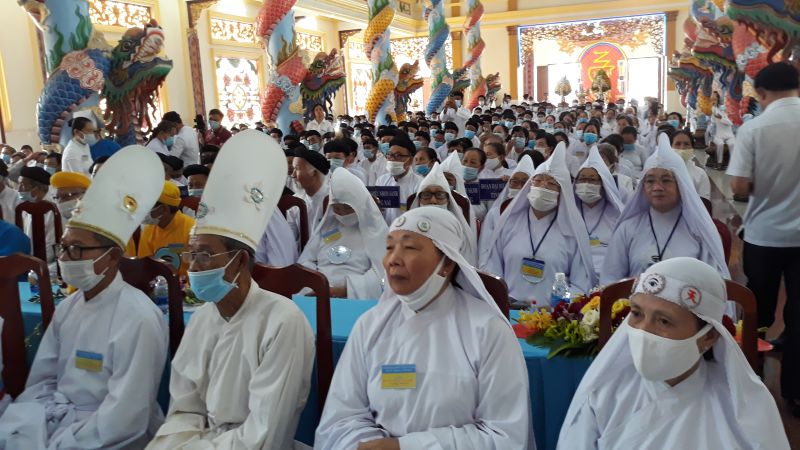
OVERVIEW OF CAO DAI IDEOLOGY
1. Định nghĩa (Definitions)
1.1. Ý thức hệ (Ideology)
Tiếng Việt:
Con người là những cá thể và quần thể sống có suy nghĩ, có tư duy. Sự suy nghĩ hay tư duy giúp cho con người có tư tưởng.
Giữa tư tưởng và ý thức có một mối liên hệ mật thiết. Đức Đông Phương Chưởng Quản đã dạy:
“Tư tưởng là gồm những ý thức trưởng thành để linh động hóa tiềm năng vô cùng của con người.”[1]
Những tư tưởng dẫn dắt nếp sống, đường lối hành động của con người, vạch ra mục đích cuối cùng của một tập thể, một dân tộc hay nhiều dân tộc gọi là “Ý thức hệ”.
English:
Human beings are individuals and communities endowed with thought and cognition. This process of thinking gives rise to ideas.
There is a close connection between thought and consciousness. As His Holiness the Oriental Chancellor taught:
"Thoughts consist of matured consciousnesses that actualize the infinite potential of human beings."[1]
The system of ideas that guides humankind's way of life and courses of action, and outlines the ultimate goals of a collective, a nation, or communities of nations, is called an "Ideology."
Tiếng Việt:
Trong “The American Heritage Illustrated Encyclopedic Dictionary”, ý thức hệ được định nghĩa:
“Ý thức hệ là phần trọng tâm hay chính yếu của tư tưởng, phản ảnh các nhu cầu và nguyện vọng của cá nhân, tập thể hay một nền văn hóa.”
“Ý thức hệ là một hệ thống học thuyết hay tín ngưỡng làm nền tảng cho một hệ thống chính trị, kinh tế hay các hệ thống khác.”[2]
Còn theo Encyclopaedia Britannica:
“Ý thức hệ là một hình thức triết học về xã hội hay chính trị, trong đó, những yếu tố thực tiễn đóng một vai trò quan trọng ngang bằng với những yếu tố lý luận. Đó là một hệ thống tư tưởng mang khát vọng đối với cả việc lý giải thế giới lẫn việc cải tổ thế giới.”[3]
English:
In The American Heritage Illustrated Encyclopedic Dictionary, ideology is defined as:
"The body of ideas reflecting the social needs and aspirations of an individual, group, class, or culture; a set of doctrines or beliefs that form the basis of a political, economic, or other system."[2]
According to the Encyclopaedia Britannica:
"Ideology is a form of social or political philosophy in which practical elements are as prominent as theoretical ones. It is a system of ideas that aspires both to explain the world and to change it."[3]
Tiếng Việt:
Một số định nghĩa trong những tài liệu khác:
- Một hệ thống quan điểm đặc biệt về đời sống con người hay về văn hóa.
- Một phương cách hay nội dung tư duy đặc thù của một cá nhân, một tập thể hay một nền văn hóa.[4]
- Một khuynh hướng thể hiện bản chất tư tưởng của một tập thể hay một quốc gia.[5]
“Ý thức hệ là hệ thống tư tưởng và quan điểm thường phản ảnh quyền lợi cơ bản khác nhau của các giai cấp, các tầng lớp xã hội.”
English:
Other reference sources define ideology as:
- A particular system of views on human life or culture.
- A specific way of thinking or the distinct cognitive content of an individual, a collective, or a culture.[4]
- A tendency that expresses the ideological essence of a collective or a nation.[5]
"Ideology is a system of thoughts and viewpoints that often reflects the distinct, fundamental interests of different social classes and strata."
Tiếng Việt:
Như vậy, khác với những loại học thuyết khác, ý thức hệ có những đặc điểm:
- Là một triết thuyết về xã hội nhân sinh;
- Chứa đựng một sự đồng hành giữa tư tưởng và hành động, giữa lý luận và thực tiễn;
- Mang tính chất chỉ đạo về mặt thực hành cho một cộng đồng (đoàn thể, cá nhân, tôn giáo, tổ chức,…) đạt được mục đích của mình.
Thus, distinct from other types of doctrines, an ideology possesses the following characteristics:
- It is a philosophical theory concerning human society and existence;
- It embodies a synchronization of thought and action, theory and practice;
- It serves as a practical guide for a community (a group, individual, religion, or organization) to achieve its goals.
Tiếng Việt:
Chủ đề “Ý thức hệ Cao Đài” hay “Ý thức hệ Đại Đạo” đã được Đức Giáo Tông Vô Vi Đại Đạo giáng cơ giảng dạy tại Cơ Quan Phổ Thông Giáo Lý vào Rằm tháng Giêng năm Giáp Dần (1974). Nghiên cứu bản thánh giáo này, ta có thể xác lập một định nghĩa về “Ý thức hệ Cao Đài”.
Trong đàn cơ này, Đức Lý Giáo Tông đặt vấn đề như sau:
“Chư hiền đệ hiền muội là những người chức sắc, chức việc, tín đồ, đạo hữu trong các hội thánh, giáo hội, thánh thất, thánh tịnh, toàn thể trong Đại Đạo, thì đã có ít nhiều liên hệ hay hiến thân để phục vụ Thánh Thể của Đức Chí Tôn. Điều mà Bần Đạo muốn nói hôm nay là hình thể đạo và giáo thuyết hay ý thức hệ Cao Đài.”[6]
Rồi Ngài lại đặt câu hỏi:
“Chư hiền đệ hiền muội có nghĩ về giáo thuyết hay ý thức hệ Cao Đài?”[7]
Như vậy, Đức Lý Giáo Tông đã sử dụng “ý thức hệ” và “giáo thuyết” như là hai danh từ đồng nghĩa: Ý thức hệ Cao Đài chính là giáo thuyết Cao Đài.
English:
The topic "Cao Dai Ideology" or "Great Dao Ideology" was revealed through mediumship by the Invisible Spiritual Pope of the Great Dao at the Agency for the Dissemination of Religious Teachings on the full moon of the first lunar month in the Year of the Wood Tiger (1974). Through studying this divine message, we can establish a definition of "Cao Dai Ideology."
In this seance, His Holiness Spiritual Pope Ly Tong posed the following:
"You, the virtuous brothers and sisters—dignitaries, sub-dignitaries, followers, and co-religionists within the holy branches, churches, temples, and shrines across the Great Dao—have all to some extent connected or dedicated yourselves to serving the Eucharist of the Supreme Being (Duc Chi Ton). What I wish to discuss today is the physical structure of the religion and its doctrine, or the Cao Dai ideology."[6]
He then asked:
"Have you ever pondered upon the doctrine or the Cao Dai ideology?"[7]
Thus, Spiritual Pope Ly Tong used "ideology" and "doctrine" as synonymous terms: the Cao Dai ideology is precisely the Cao Dai doctrine.
Tiếng Việt:
Từ đây, ta đi đến định nghĩa như sau:
Ý thức hệ Cao Đài là hệ thống giáo thuyết Cao Đài. Đó là một hệ thống tư tưởng và quan điểm, đúc kết từ đức tin, lý tưởng và ý thức sứ mạng Cao Đài, được đặt trên nền tảng vũ trụ quan và nhân sinh quan, thể hiện mục đích, tôn chỉ, và lập trường của Đại Đạo Tam Kỳ Phổ Độ, làm nguyên tắc chỉ đạo cho sự sống đạo, hành đạo và thi hành sứ mạng của người tín đồ Đại Đạo trong công cuộc cứu thế kỳ ba.
Ý thức hệ Cao Đài cũng chính là ý thức hệ Đại Đạo. Thật vậy, Đức Giáo Tông Vô Vi Đại Đạo đã dạy:
“Ý thức hệ chơn chính Đại Đạo đã quá sáng tỏ, làm chói mắt cả thế nhân; rồi nhân thế lại tưởng tượng rằng chân lý của Đại Đạo chỉ là ánh sáng trong tầm mắt hạn hẹp, hay tưởng tượng quẩn quanh của riêng mình mới thật đáng thương. Cao Đài không là Cao Đài, đó chính thị là Cao Đài.”[8]
Trong một đàn cơ khác, Ngài cũng đã đề cập đến “ý thức hệ của Đại Đạo Tam Kỳ Phổ Độ trong buổi hạ nguơn nầy.”[9] Những sự kiện này cho thấy rằng ý thức hệ Cao Đài là ý thức hệ Đại Đạo.
English:
From this premise, we arrive at the following definition:
The Cao Dai ideology is the system of Cao Dai doctrine. It is a comprehensive system of thoughts and perspectives synthesized from the faith, ideals, and sense of mission of Cao Dai. Grounded upon its unique cosmology and outlook on human life, it manifests the purpose, principles, and stance of the Third Amnesty of God (The Great Dao of the Three Periods of Universal Salvation). It serves as the guiding principle for living the faith, practicing the religion, and fulfilling the mission of Great Dao followers in this third era of world salvation.
The Cao Dai ideology is also identical to the Great Dao ideology. Indeed, the Invisible Spiritual Pope of the Great Dao taught:
"The true ideology of the Great Dao is already so clear that it dazzles the world; yet mortals pitifully imagine that the truth of the Great Dao is limited to their narrow vision or confined within their own circular imagination. Cao Dai is not merely Cao Dai; that is precisely what Cao Dai truly is."[8]
In another seance, His Holiness also mentioned "the ideology of the Great Dao of the Three Periods of Universal Salvation in this final cosmic cycle (the Third Transition)."[9] These accounts confirm that the Cao Dai ideology is fundamentally the Great Dao ideology.
Tiếng Việt:
Trong ý thức hệ Đại Đạo, sự song hành giữa lý thuyết và thực hành, giữa lý tưởng và thực tiễn, giữa tinh thần và vật chất, tâm linh và nhân sinh, đã được Đức Quan Thế Âm Bồ Tát dạy như sau:
“Ý thức hệ đã ràng buộc con người với con người trong thế giới hiện hữu. Dầu muốn hay không muốn thì tâm vật song hành, hai phương diện trong một con người. Lìa vật không có tâm, bỏ tâm không có vật. Thế nên sứ mạng đại thừa là thực tiễn cứu cánh vạn khổ chúng sanh hòa mình trong xã hội nhân loại. Thể dụng ứng biến hình danh công cụ tâm vật bình hành. Tất cả đều hoàn hảo trong một cuộc sống ung dung tự do tự toại"[10]
English:
Within the Great Dao ideology, the parallel progression between theory and practice, ideals and reality, spirit and matter, and spirituality and human existence was taught by Bodhisattva Guanyin (Quan The Am Bo Tat) as follows:
"Ideology binds human to human in this existential world. Whether one wishes it or not, mind and matter proceed in tandem—two dimensions within a single human being. Apart from matter, there is no mind; discarding the mind, no matter can exist. Therefore, the Mahayana mission is the practical, ultimate salvation of all sentient beings from suffering, by integrating into human society. Essence and application adapt dynamically; forms, names, and tools operate through the balance of mind and matter. All achieve perfection in a life of complete serenity, freedom, and self-fulfillment."[10]
Tiếng Việt:
Trước khi nhận định về ý thức hệ Cao Đài một cách toàn diện, chúng ta hãy khảo sát từ nguồn gốc đến nền tảng, cơ cấu của ý thức hệ này, bao gồm:
- Trọng tâm của đức tin Cao Đài
- Lý tưởng Đại Đạo
- Sứ mạng Đại Đạo Tam Kỳ Phổ Độ
- Nền tảng tư tưởng Cao Đài
- Đường lối hành đạo và sống đạo
Cuối cùng, sự lý giải các hệ quả của ý thức hệ được xem như là một kiểm chứng xác minh hệ thống tư tưởng và quan điểm của ý thức hệ hoàn toàn phù hợp với nền giáo lý Đại Đạo, bao gồm mục đích, tôn chỉ, lập trường và đạo pháp, từ giáo thuyết đến thực tiễn.
THIỆN CHÍ
English:
Before evaluating the Cao Dai ideology comprehensively, let us survey its origins, foundations, and structure, which encompass:
- The core of the Cao Dai faith
- The ideals of the Great Dao
- The mission of the Great Dao of the Three Periods of Universal Salvation
- The foundational philosophy of Cao Dai
- The path of religious practice and living the faith
Ultimately, interpreting the corollaries of this ideology serves as a validation, verifying that its conceptual framework and viewpoints align perfectly with the broader Great Dao teachings—encompassing its purpose, tenets, stance, and esoteric/exoteric practices, from pure doctrine to everyday practice.
_____________________
[1]Đức Đông Phương Chưởng Quản; Trúc Lâm Thiền Điện, Tý thời, 17 rạng 18-07 Canh Tuất (18-08-1970)
[2]The American Heritage Illustrated Encyclopedic Dictionary: “Ideology: The body of ideas reflecting the social needs and aspirations of an individual, group, class, or culture; A set of doctrines or beliefs that form the basis of a political, economic, or other system.”
[3]Encyclopaedia Britannica: “Ideology: a form of social or politician philosophy in which the practical elements are as prominent as theoretical ones. It is a system of ideas, that aspires both to explain the world and to change it.”
[4]IDEOLOGY:
1 : a systematic body of concepts especially about human life or culture
2 : a manner or the content of thinking characteristic of an individual,
group, or culture —ideo·log·i·cal also idea·log·i·cal /"Id-E-&-'lj-i-k&l/
adjective —ideo·log·i·cal·ly /-i-k(&-)lE/ adverb
(Merriam-Webster Medical Dictionary, © 2002 Merriam-Webster)
1 : a systematic body of concepts especially about human life or culture
2 : a manner or the content of thinking characteristic of an individual,
group, or culture —ideo·log·i·cal also idea·log·i·cal /"Id-E-&-'lj-i-k&l/
adjective —ideo·log·i·cal·ly /-i-k(&-)lE/ adverb
(Merriam-Webster Medical Dictionary, © 2002 Merriam-Webster)
[5] IDEOLOGY:
- an orientation that characterizes the thinking of a group or nation
[syn: political orientation, political theory] (Source: WordNet ® 1.6, © 1997 Princeton University)
- an orientation that characterizes the thinking of a group or nation
[syn: political orientation, political theory] (Source: WordNet ® 1.6, © 1997 Princeton University)
[6]Đức Giáo Tông Vô Vi Đại Đạo; Cơ Quan Phổ Thông Giáo Lý, Tuất thời, 15-01 Giáp Dần (06-02-1974)
[7]Đức Giáo Tông Vô Vi Đại Đạo; Cơ Quan Phổ Thông Giáo Lý, Tuất thời, 15-01 Giáp Dần (06-02-1974)
[8]Đức Giáo Tông Vô Vi Đại Đạo; Cơ Quan Phổ Thông Giáo Lý, Tuất thời, 15-01 Giáp Dần (06-02-1974).
[9]Đức Giáo Tông Vô Vi Đại Đạo; Thiên Lý Đàn, Tuất thời, 07-01 Kỷ Dậu (23-02-1969)
[10]Đức Quan Âm Bồ Tát; Cơ Quan Phổ Thông Giáo Lý, 15-07 Đinh Tỵ (1977)
THIỆN CHÍ (GOODWILL)Các bài Thánh giáo- Thánh ngôn khác


Video
